
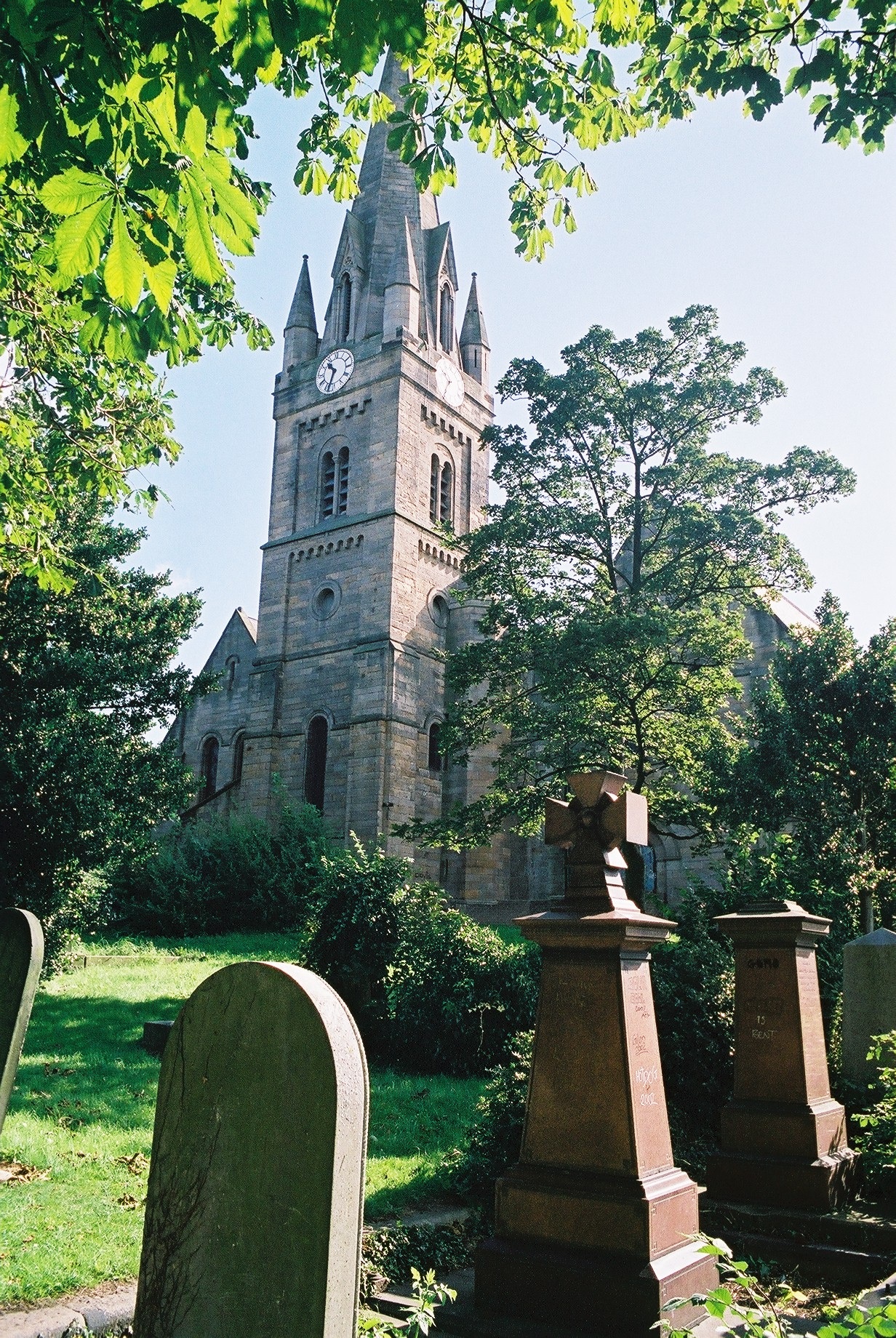
St James’ Church and its adjacent churchyard were consecrated in 1832. The graveyard originally consisted only of the land between the church and the vicarage, and the earliest graves are therefore to be found in this area. It was extended in 1858 because of the large number of burials – many from the workhouse. Further land was added in 1899, forming the graveyard as we know it today. The graveyard was closed for burials in 1966 and its maintenance is now the responsibility of the City Council. However for several years St James’ Heritage & Environment Group has carried out the bulk of the maintenance work, with a group of volunteers meeting weekly to weed, tidy and plant the area. The Group has also raised money to repair and improve the graves, including obtaining a grant from the Heritage Lottery Fund, and has installed a number of interpretation boards on site providing information for visitors.
The official records of graves at St James’ were lost over the years. However in 2009, the Group began the major project of mapping and documenting the graves and collecting information about the people buried there. There are over 625 marked graves in the graveyard but most of those buried at St James’ have no visible memorial. Using the burial records, the Group has been able to identify the location of most of those buried there even where there is no visible marker. The data-bases created enable the Group to answer queries from the public about burials, to provide information about the location of particular graves and about the related family history. Most queries are received by email as people find out about the Group’s work through its website. In recent years, visitors have been welcomed from distant places such as Canada and New Zealand as well as from other areas of the UK. The Group also holds copies of the original burial records, which are available to be consulted.
Who is buried at St James’
Our research suggests that 12,547 people were buried in the graveyard between 1833 and 1966. The first recorded burial at St James’ was that of Elizabeth Clark of Benwell Colliery who died at the age of five, and the last burial is believed to have been Mary Holmes who was born in 1890 and died in 1953. A variety of occupations and ages are represented among the burials, and there are 20 official Commonwealth War Graves, as well as others who died as a result of war.
The graveyard contains the graves of members of many rich and powerful families who used to live in and around Benwell in earlier years. Probably the most famous of these was Richard Grainger, the builder and developer who was largely responsible for the re-development of Newcastle’s city centre in the 19th century. Also buried there are hundreds of local residents who were not so wealthy or famous, including pitmen, local traders, and inhabitants of the workhouse which used to be on the site of the General Hospital.
Can we help you?
We may be able to help you find out more about your family history or about local history by sharing our research with you. We have a database of all of the burials which were recorded and where possible their location, and also copies of the burial records which are available for viewing by arrangement.
Email us at stjamesbenwell@gmail.com or write c/o Sunnybank Centre, 12/14 Sunnybank Avenue, Pendower, Newcastle upon Tyne, NE15 6SD.
Visit us on a Wednesday morning between 10 am and 1pm for information and informal tours.
Can you help us?
If you are interested in supporting our efforts in any way, we would welcome your participation, whether it is doing a bit of weeding and tidying or bringing information about your ancestors buried there.
We meet at the graveyard on Wednesdays between 10am and 1pm.
Find out more about St James’ Graveyard
The following publications are available to view here. Printed copies are available on request.
A Guide to St James’ Graveyard
St James’ Church, Benwell, is one of the oldest churches in Newcastle. This book introduces some of the people buried in its graveyard including pitmen, boatmen, soldiers, farmers, shopkeepers and inhabitants of the local workhouse, as well as members of many of the richest and most powerful families on Tyneside.
St James’ Heritage & Environment Group 2014
A Short History of St James’ Graveyard, Benwell
The story of Benwell’s parish graveyard from its consecration in 1832 at a time when this was a fashionable area populated by some of the wealthiest and most powerful families on Tyneside, until its closure in 1966.
St James’ Heritage & Environment Group 2019
St James’ Graveyard: Children’s Challenge
This leaflet is an ideal introduction to St James’ graveyard for people of all ages. It contains information about the history and wildlife of the graveyard and the local area, with a trail and activities suitable for groups or individuals.
War graves and memorials at St James’ Church
This is a guide to the Commonwealth War Graves and family graves commemorating people who died on active service, and war-related memorials inside the church. It includes a plan showing the locations of these and information about some of the individuals commemorated.
St James’ Graveyard, Benwell – Hidden Nature
A haven for wildlife and a valuable green space in this urban area
RESTORING THE GRAVEYARD
– In 2016 St James’ Heritage and Environment Group obtained a grant from the Heritage Lottery Fund which enabled us to commission a specialist stonemason/conservator to work with us over a two-year period to repair and restore many of the damaged gravestones.
To start at section from lottery grant, click here
to see the section on removing moss, click here.
To see the section on repairing gravestones, click here.
To see the section on restoring the Buddle grave, click here.
To see the section on restoring the Grace grave, click here.
To see the section on removing graffiti, click here.

